
SEO or Google Ads: which should your business invest in first?
SEO and Google Ads can both create visibility and enquiries, but they work on different timescales and carry different costs, strengths and risks. The right starting point depends on the condition of your website, whether people already search for your service, how quickly you need results and what you can realistically invest.
This guide gives you a practical comparison without pretending that one channel is universally better—or that every business should automatically pay for both.
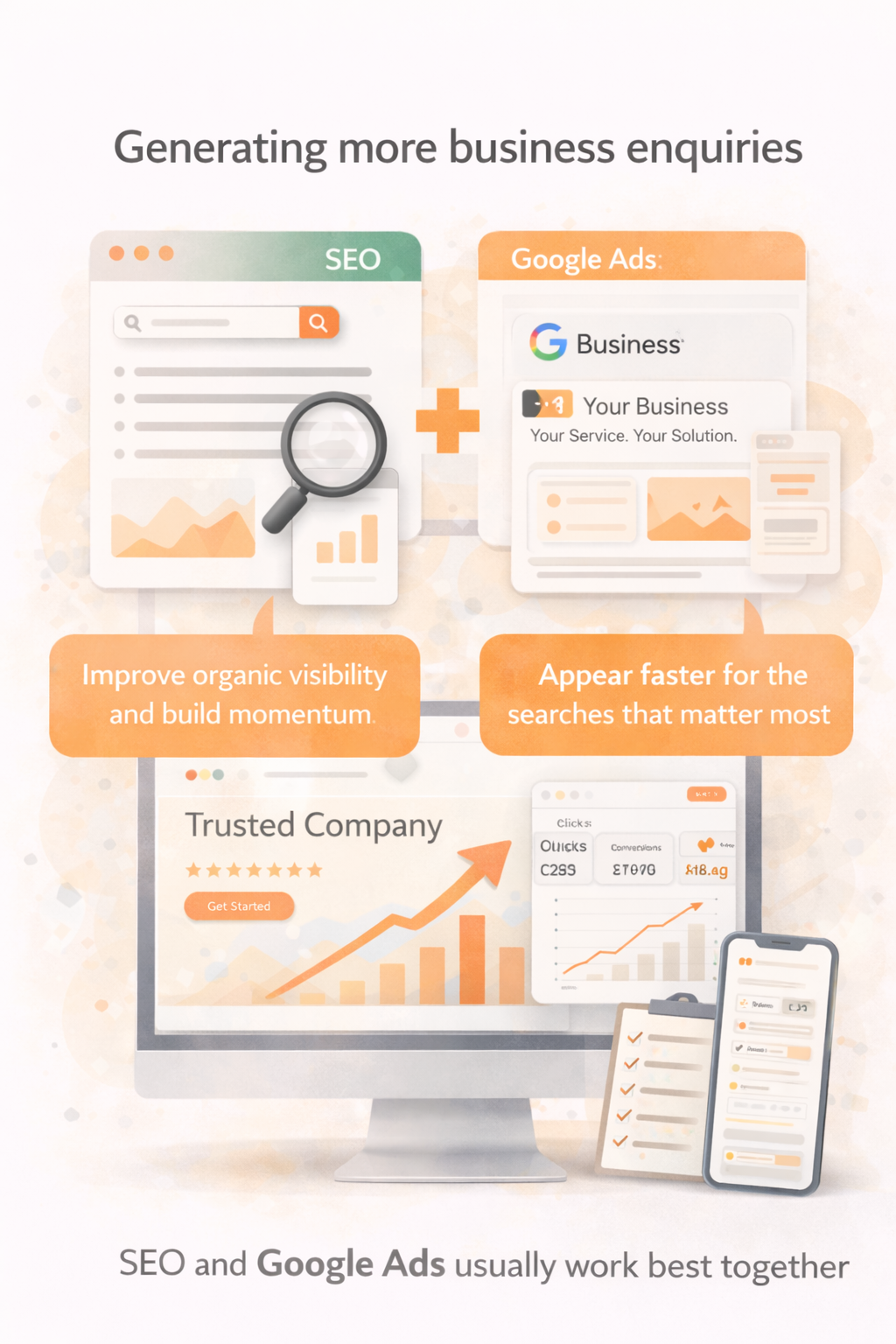
Choose according to the problem you need to solve first
The most important question is not “Which channel is better?” It is “What is currently preventing this business from generating worthwhile enquiries?”
You want to build durable visibility
Your website is credible, your customers research online and you can invest consistently while useful pages and authority build over time.
You need to reach active demand sooner
People already search for your service, your offer and landing page are clear, and the value of a customer can support the cost of advertising.
Your current page is likely to lose the visitor
If the offer is vague, the website feels untrustworthy or there is no clear enquiry route, more visibility may simply expose those weaknesses to more people.
SEO develops visibility. Google Ads purchases immediate access to it.
Both can put your business in front of someone who is researching or ready to buy. The difference is how that position is earned, paid for, controlled and sustained.
SEO and Search Visibility
SEO improves how your website and wider business presence are understood across conventional search, local results, recommendation sources and increasingly AI-generated answers.
You do not pay Google for each organic click, but you invest in research, technical improvements, stronger pages, evidence and authority. Progress is normally cumulative rather than immediate.
Google Ads
Google Ads lets you enter an auction for selected searches. You can define locations, budgets and campaign themes, then pay Google for the traffic generated through the advertisements.
Visibility can begin much sooner, but it depends on ongoing ad spend. A campaign also needs relevant targeting, reliable tracking and a page capable of converting the click.
Using both
A combined strategy can make sense when the website is ready, sufficient budget exists and the business can handle additional enquiries.
Ads can test and capture current demand while SEO develops broader visibility. But splitting an inadequate budget between two underfunded channels is not automatically a stronger strategy.
How SEO and Google Ads differ in practice
These are general differences rather than guarantees. Competition, demand, website quality and execution can materially change the outcome of either channel.
| Decision area | SEO & Search Visibility | Google Ads |
|---|---|---|
| Time to visibility | Usually develops gradually | Can begin after setup and approval |
| How you pay | For expertise, implementation and content—not per organic click | Service fee plus advertising spend paid to Google |
| When investment pauses | Existing visibility may continue, but can weaken without maintenance | Paid visibility normally stops when the campaign stops |
| Control | Indirect; platforms decide rankings, citations and recommendations | More control over budget, targeting and timing, within Google’s auction |
| Coverage | Can support Google, maps, recommendations and AI discovery | Targets paid placements within the selected Google campaigns |
| Testing demand | Slower feedback cycle | Can produce search and conversion data sooner |
| Main risk | Investing in weak or generic content without a clear strategy | Paying for irrelevant clicks or sending good clicks to a weak page |
| Usually strongest when | The business can invest consistently and has expertise worth surfacing | Demand exists, customer value supports the cost and tracking is possible |
Choose SEO when building discoverability is the larger strategic need
SEO is often the better first investment when the website is fundamentally sound but does not explain enough, target the right subjects or demonstrate the experience behind the business.
It is particularly useful when customers research carefully, compare providers, ask detailed questions or use several sources before making contact.
SEO may be the better starting point when:
- You want visibility that is not dependent on paying for every click
- Your customers research questions and compare expertise before buying
- The business has useful knowledge that is not represented online
- You can invest consistently without requiring immediate returns
- You want to improve visibility across search, local results and AI discovery
- Your website already gives visitors a credible reason to enquire
SEO is quoted according to the website, market and work required. Read about my SEO and Search Visibility approach.
Google Ads may be the better starting point when:
- People are already actively searching for the service
- You need visibility sooner and have budget available to test it
- A successful customer is valuable enough to support paid acquisition
- You serve defined locations or clearly defined customer needs
- The landing page is credible, relevant and easy to act upon
- You can track calls, forms and which enquiries become customers
Focused Google Ads setup starts from £165, with advertising spend paid separately to Google. Read about Google Ads Setup.
Choose paid search when suitable demand exists and speed has genuine value
Google Ads can be a sensible starting point when potential customers already search for a specific service and the business is ready to turn that interest into calls or forms.
It can also help test whether a service, location or message attracts interest before waiting for organic visibility. But faster feedback is not the same as guaranteed profitability.
More traffic will not repair an unclear or unconvincing website
If visitors cannot understand the offer, trust the business or find a sensible next step, both SEO and Google Ads may deliver attention that the website fails to turn into an opportunity.
The offer is unclear
The site uses general statements but does not explain exactly what is provided, who it is for or why somebody should choose it.
The business is hard to trust
The website lacks credible presentation, useful detail, named experience, reviews, examples or transparent information.
The enquiry route is weak
The next step is difficult to find, too demanding, broken on mobile or disconnected from what the visitor has just read.
What might make sense at different stages
These examples are starting points, not universal prescriptions. A review of the website, demand, competition and commercial numbers should come before a firm recommendation.
A new local service business
The offer is clear, customers search locally and each new client has meaningful value, but the business has little existing visibility.
Likely starting point: establish a credible website and local-search foundations, then consider a tightly focused ad campaign if the budget can support testing.
An established specialist with a weak online presence
The business has years of experience and referrals, but the website contains very little useful information and does not demonstrate that expertise.
Likely starting point: improve the website and invest in SEO-led content and authority. Ads may be unnecessary until the online offer is stronger.
A business needing to fill capacity
The website is credible, enquiry handling is reliable and the business needs more suitable opportunities within the next few weeks.
Likely starting point: Google Ads may provide faster access to active demand, with clear tracking used to judge whether the economics work.
A business already investing in growth
The website converts, useful search demand exists and the business has enough budget and capacity to support more than one channel properly.
Likely starting point: use Ads for selected immediate opportunities while SEO develops broader and more durable visibility.
Four assumptions that can lead to poor investment decisions
“SEO is free traffic”
Organic clicks are not billed individually, but useful SEO requires research, technical work, content, evidence and sustained attention.
“Google Ads guarantees immediate leads”
Ads can create immediate visibility. They cannot guarantee demand, suitable clicks, enquiries or customers.
“SEO stops mattering because of AI”
AI has broadened discovery, but clear websites, useful information and external authority also help machines understand which sources and businesses deserve attention.
“Doing both is always best”
Using both can be powerful, but only when the website, budget, tracking and business capacity are strong enough to support both properly.
Questions about choosing SEO or Google Ads
Which is cheaper: SEO or Google Ads?
There is no universal answer. Ads include both a service cost and continuing spend paid to Google. SEO requires investment in improvements and content but does not charge per organic click. The better comparison is cost per worthwhile customer over an appropriate period.
Which produces results faster?
Google Ads can normally create visibility sooner after setup and approval. SEO usually takes longer to develop, although the timescale varies significantly by website, market and starting position.
Can I test Google Ads before committing to SEO?
Yes, if genuine search demand exists and the website is ready. Ads can provide useful data about searches and enquiries, but a short or underfunded test may not be enough to establish reliable performance.
Will SEO keep working if I stop paying for it?
Existing pages and rankings do not automatically disappear, but visibility can change as competitors improve, search systems evolve and information becomes outdated. SEO is an asset that still needs maintenance.
Should a new business use both immediately?
Not automatically. A new business may achieve more by concentrating its limited budget on the website and the single channel best matched to its immediate situation.
Can you recommend the right starting point?
Yes. I can review the offer, website, likely search demand, timescale and available budget, then explain whether the website, SEO, Google Ads or a combination appears most sensible.
Still unsure which investment should come first?
Tell me about your business, current website, budget and how quickly you need enquiries. I will give you a straightforward recommendation—even if the most sensible answer is to improve the website before investing in either channel.